Stop launching blindly into unvalidated markets. Discover how to build synthetic user personas using advanced LLMs to ruthlessly stress-test your business model, value proposition, and copy.
Stress-test your business model. The traditional market research phase for early-stage startups is notoriously slow, expensive, and frequently inaccurate.
Conducting customer discovery interviews, distributing surveys across social platforms, and compiling focus groups often yields skewed data. Human participants, even when well-intentioned, frequently display confirmation bias, telling founders what they want to hear rather than how they would actually behave when confronted with a real checkout page.
To build a genuinely resilient property, you cannot rely on polite feedback. You need to uncover harsh market objections, hidden feature demands, and positioning flaws before you deploy your primary advertising budget. In modern business ecosystems, forward-looking companies are bypassing slow traditional focus groups entirely by engineering data-dense simulation networks.
By leveraging advanced Large Language Models (LLMs), you can construct multi-layered synthetic user personas that ruthlessly stress-test your business model, landing page copy, and value metrics under precise behavioural constraints. Here is the technical operational blueprint to simulating market resistance automatically.
🛑 The Validation Bottleneck: Why Passive Feedback Kills Conversions
The primary point of failure for new digital products is a fundamental lack of market alignment. When founders seek early feedback, they often ask friends, peer groups, or casual communities for thoughts on their concept. This passive validation creates a false sense of security. True validation only occurs when a system is subjected to genuine friction, cost scrutiny, and real-world objections.
Deploying deep simulation models allows you to identify critical operational and positioning flaws early. Your internal engineering must actively simulate these three behavioural variables:
-
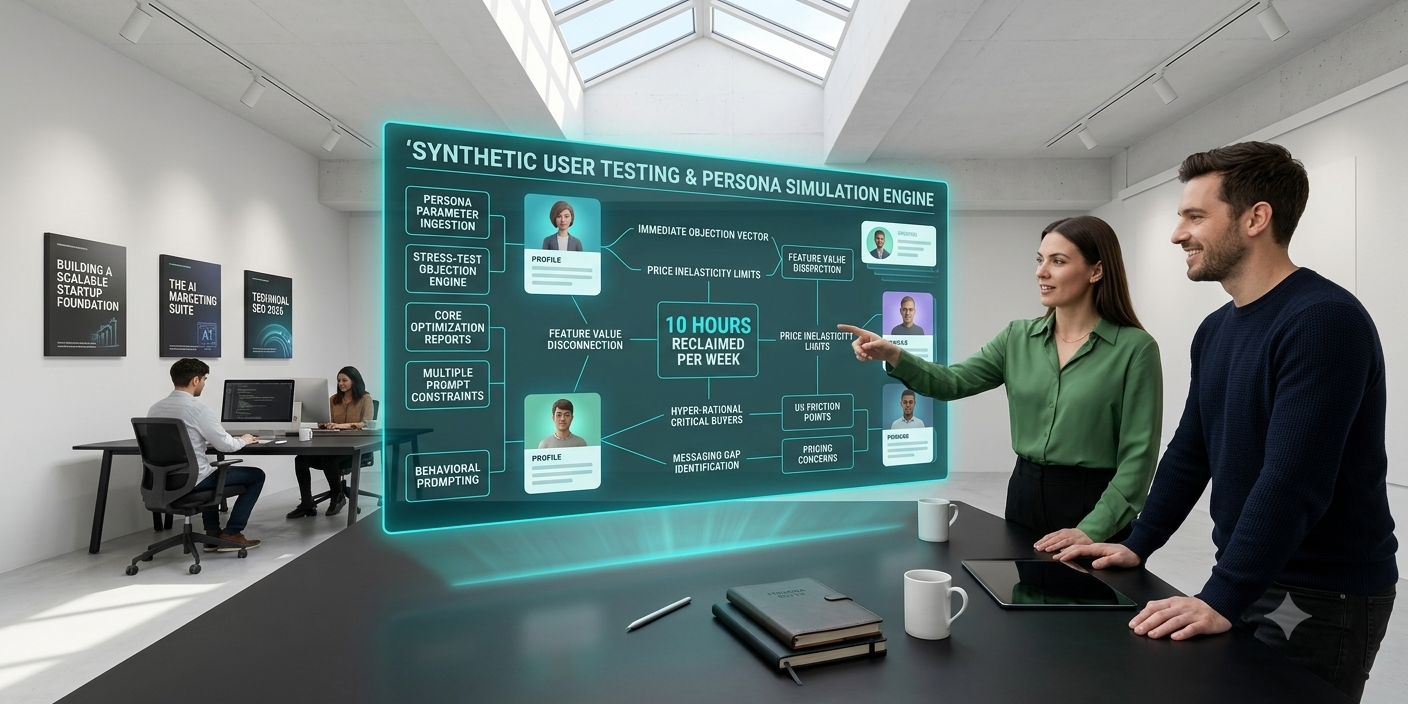
The Immediate Objection Vector: Identifying the exact friction point that causes a target user to bounce from your dashboard within the first five seconds.
-
Feature Value Disconnection: Pinpointing components of your software or service layout that your team values, but the market views as unnecessary bloat.
-
Price Inelasticity Limits: Forcing your system to simulate varying pricing structures against strict economic limits to find the absolute ceiling of your market’s purchasing power.
🛠️ The 3-Tier Synthetic Market Simulation Framework
Engineering an enterprise-grade testing loop requires structuring custom AI agents into an isolated, data-dense testing environment.
[Tier 1: Persona Parameter Ingestion] ──(Behavioral Prompting)──> [Tier 2: The Stress-Test Objection Engine] ──> [Tier 3: Core Optimisation Reports]
1. Persona Parameter Ingestion
Your synthetic users cannot be generic AI setups. You must build highly specific context profiles. Feed your local model raw data points scraped from active communities, customer support logs, and competitor review threads.
Define your persona’s exact professional variables: their specific job title, software budget constraints, daily operational frustrations, technical skill level, and historical purchasing behaviours.
2. The Stress-Test Objection Engine
Once your personas are instantiated, introduce them to your digital assets. Pass your landing page text, checkout logic, and core feature descriptions directly into the simulation loop. Program the agents to act as highly critical, hyper-rational buyers. Instruct them to find flaws in your messaging, flag ambiguous copy, and state exactly why they would walk away from the transaction in favour of an alternative provider.
3. Core Optimisation Reports
The final tier compiles the simulated conversational outputs into structured, machine-readable datasets. The system extracts pattern repetitions across fifty distinct persona runs, highlighting consistent UX friction points, messaging gaps, and pricing concerns.
This automated feedback loop provides your product team with clear, actionable development priorities, letting you optimise your front-end experience before launching live traffic.
📊 Testing Methodology: Human Focus Groups vs. Synthetic Simulators
Review the strategic comparison below to see how deploying automated synthetic user testing optimises your go-to-market speed:
| Operational Variable | Traditional Human Focus Groups | Synthetic LLM Simulation Networks | Strategic Growth Impact |
| Testing Speed | 2 to 4 weeks to coordinate, interview, and organise data. | 3 to 5 minutes to run hundreds of varied persona profiles. | Drastically increases pivot velocity and messaging precision. |
| Data Objectivity | Prone to courtesy bias and polite, non-binding feedback. | Hyper-rational, unemotional, and ruthlessly critical analysis. | Exposes underlying conversion bottlenecks immediately. |
| Resource Efficiency | Requires high financial capital, incentives, and manual labour. | Zero-marginal-cost processing via integrated API calls. | Saves over 10 hours a week of manual compilation tasks. |
❓ Frequently Asked Questions
Q1: Can synthetic AI personas truly replicate real human purchasing decisions?
While an LLM simulation cannot completely replace human interaction, advanced models trained on vast behavioural and psychological datasets excel at predicting contextual objections. They map broad patterns of human hesitation, financial skepticism, and cognitive load with remarkable precision, making them perfect for catching foundational layout and messaging errors before real-world testing.
Q2: What is the optimal number of synthetic personas required to validate a concept?
For clear, actionable results, build an array of 5 to 10 distinct target profiles representing your core customer cohorts. Run each profile through your system multiple times under varying prompt constraints (e.g., varying their frustration levels or budget limits) to generate a robust database of feedback points.
Q3: How do we align this testing strategy with our broader digital architecture?
The data extracted from your simulation engine should feed directly into your primary database structure. If your platform is built on an agile no-code MVP stack, you can instantly implement the text changes, layout adjustments, and product updates suggested by the AI models without relying on a slow engineering sprint.
Q4: How does synthetic stress-testing help improve our organic search visibility?
Synthetic testing helps you discover the exact conversational phrases and deep search intents your target audience uses when looking for answers. By integrating these specific long-tail queries back into your core content cluster strategy, you naturally optimise your architecture to rank highly on modern search tools.
🚀 Build Your Unbeatable Market Validation Stack Today
Maximising conversion velocity requires absolute operational clarity, data-driven systems engineering, and modern testing frameworks. Stop launching blindly into unvalidated markets. Access our comprehensive step-by-step masterclasses designed to give modern professionals the exact technical playbooks needed to scale efficiently across the Business Startup Network:
-
Deploy Enterprise AI Testing Frameworks: Learn how to engineer customised AI nodes, manage automated user personas, and build conversion loops by joining The AI Marketing Suite: Automating Engagement and Acquisition Course.
-
Construct Scalable, Automated Product Pipelines: Discover how to connect transactional webhooks, automate backend database tables, and scale your product ecosystems smoothly with Automating Sales Funnels with AI and No-Code Tools: Scale Your Business Effortlessly.
-
Dominate Organic Search and Discovery Channels: Position your optimised properties at the absolute top of traditional and AI search engines by mastering The Founder’s Guide to Technical SEO: Dominating Search in 2026.
-
Build an Investor-Ready Corporate Asset: Learn the technical secrets behind structuring pristine corporate governance, managing team velocity, and optimising cash runway with Strategic Growth & Operational Readiness: Building a Scalable Startup Foundation.
-
Access Field-Tested Operational Schemas Instantly: Skip the lengthy prompt-testing phase entirely. Download instant, actionable persona configurations, data schemas, and API templates directly from our Ebooks Shop.