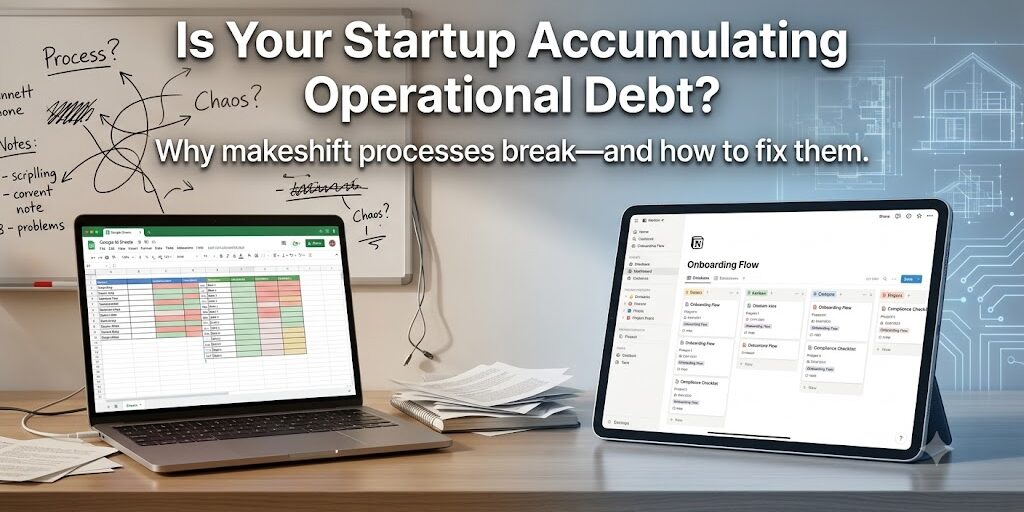
Chaotic operations are often worn as a badge of honor in early-stage UK startups. Discover why your “makeshift” processes are accumulating silent operational debt and how to fix them before you scale.
We’ve all seen the classic startup trap: the “it works on my machine” mentality. In the early days of a new venture, chaotic operations are easily mistaken for agility. You have one person handling the CRM on a scrappy spreadsheet, another managing invoicing via messy email threads, and a developer launching code by the skin of their teeth.
But here is the hard truth: Chaos doesn’t scale; it accumulates operational debt. Just like technical debt, operational debt catches up to you the exact moment you try to make your first key hire or take on pre-seed funding. If your onboarding process requires you to sit next to a new hire for three days straight just to explain “how we do things,” your business is brittle.
🔍 3 Ways to Audit Your Startup’s Ops This Week
-
Establish a Single Source of Truth Stop letting critical data live in WhatsApp groups or siloed Slack DMs. Pick a central hub—whether it’s Notion, Airtable, or ClickUp—and mandate that if a process isn’t documented there, it doesn’t exist.
-
Standardise Before You Automate Don’t waste money buying complex automation tools for a broken workflow. Write down the step-by-step process manually first. If a human can’t follow it clearly, a Zapier integration won’t fix it.
-
Build for the “Hit by a Bus” Metric If your operations manager or sole tech lead stepped away for a week, would your startup survive? Document the critical paths today so the business isn’t entirely dependent on one person’s memory.
The Takeaway: Growth hides operational flaws, but scaling exposes them ruthlessly. Fix the foundation while you are small, so you don’t fracture when you get big.
What Invisible Operational Debt Actually Looks Like
When ‘Makeshift’ is the dominant culture, this invisible debt accumulates silently across your foundation. You won’t see it on a balance sheet, but you will feel it when your team starts spending 40% of their time just managing data entry rather than growing the business.
This debt manifests as duplicated work, a reliance on ‘insider knowledge’ (where only one person knows how to generate an invoice), and the crucial ‘Hit-by-a-Bus’ vulnerability. If your operations manager is unavailable, does your business grind to a halt? If the answer is yes, your operations are brittle.
Standardising your core processes, the repeatable actions like client onboarding, compliance checklists, or deployment workflows, is not a bureaucratic chore. It is an act of strategic wealth creation. By shifting from ‘it works on my machine’ to ‘it works on our system‘, you build a Single Source of Truth that scales with you.
Don’t wait until you take investment. Begin mapping these workflows now, while you are small. The true value of a startup isn’t just the product; it’s the efficient, predictable infrastructure you build around it.
Founder, don’t let invisible debt become visible failure. What makeshift process are you standardizing this week? Let’s commit and discuss below.
The Warning Signs of Invisible Operational Debt
How do you know if your startup is already buckling under the weight of its own makeshift systems? Operational debt doesn’t announce itself with a broken server or a sudden drop in website traffic. Instead, it leaks into your day-to-day culture through subtle, frustrating friction points.
You are heavily in operational debt if you notice any of these red flags:
-
The “Whisper Network” Dependency: New team members have to constantly ask around in Slack or WhatsApp just to find basic assets, log-ins, or brand guidelines because nothing is centrally indexed.
-
The Groundhog Day Bottleneck: You find yourself solving the exact same operational issue every single month because nobody took five minutes to document the fix the first time it happened.
-
The Key-Person Risk: If you or a specific engineer/ops manager took a sudden two-week holiday, critical business functions (like customer onboarding or invoicing) would completely grind to a halt.
When these habits set in early, they create an invisible ceiling. You might have the best product-market fit in your industry, but if your internal engine is held together by digital duct tape, you will tear your operations apart the moment you try to accelerate.
The Real Cost: Why Investors Care About Your Infrastructure
Many founders believe that operational efficiency is something you only worry about after securing a major funding round. They treat it as a luxury for later. This is a massive miscalculation, especially in today’s highly competitive UK investment landscape.
When angel investors or venture capitalists conduct due diligence, they aren’t just looking at your financial spreadsheets and your user growth metrics. They are evaluating your ability to actually deploy their capital effectively. If an investor digs into your business and finds that your entire sales pipeline relies on a chaotic, unmonitored spreadsheet or that your customer data is fragmented across three different personal accounts, it signals a massive risk.
An unorganized backend tells investors that if they give you £500k to scale up, a significant portion of that money will be wasted fighting preventable operational fires rather than driving pure growth. Clean, standardised infrastructure is a powerful selling point; it proves that your startup is a highly scalable engine, not just a fragile project.
Moving Forward: The “Minimum Viable Documentation” Approach
Fixing this problem doesn’t mean you need to pause your growth to write a massive, 100-page corporate policy manual. In fact, over-complicating your documentation will only ensure that your team ignores it.
Instead, aim for Minimum Viable Documentation (MVD). For every critical process in your business, create a simple, one-page guide that answers three basic questions:
-
What is the goal of this process?
-
Where does the necessary data or tool live?
-
What are the exact, step-by-step actions required to complete it?
Keep it short, clear, and highly practical. Use Loom videos, bullet points, or simple flowcharts. By keeping the barrier to entry low, you make it easy for your team to maintain the documentation as your startup evolves.
The Bottom Line: Your early speed was powered by pure hustle. Your future scale must be powered by systemized structure. Take the time to audit your foundation today, clear out your operational debt, and build a business that is truly engineered to grow.