
Do I need a shareholders’ agreement if I am a solo founder?
If you own 100% of your company, you do not strictly need a shareholders’ agreement. However, the moment you take on a co-founder, assign equity to an early employee, or accept investment, a shareholders’ agreement is vital to protect your business assets and dictate how equity disputes are legally handled.
When starting a business with partners, everyone is fueled by optimism. But launching without a clear legal framework is one of the most common reasons early-stage startups fail.
Think of a Shareholders’ Agreement as a business prenuptial agreement. It outlines exactly what happens if someone wants to leave, how decisions are made, and how to resolve deadlocks before they break the company.
Why standard “Model Articles” are not enough
When you register a company at Companies House, you are assigned generic legal guidelines called “Model Articles of Association.” While these satisfy the government, they are entirely public documents and fail to address real-world founder scenarios:
-
What happens if a co-founder walks away after 3 months but wants to keep 50% of the company?
-
How do you resolve a 50/50 voting split when you completely disagree on a business pivot?
-
Can a minority shareholder block you from selling the business down the line?
A private Shareholders’ Agreement overrides these gaps.
3 Vital Clauses for Bootstrapped Startups
1. Founder Equity Vesting (The “Anti-Runner” Protection)
Never give away chunks of equity upfront unconditionally. Implement a vesting schedule (e.g., a 4-year vest with a 1-year “cliff”). This means if a co-founder quits within the first 12 months, they leave with 0% of the company. Their equity transfers back to the business, preserving it for future partners or investors.
2. Drag-Along and Tag-Along Rights
-
Drag-Along: If a majority of shareholders (e.g., 75%) want to sell the company to a buyer, they can “drag” the minority shareholders into the sale. This prevents a tiny shareholder from tanking a life-changing acquisition.
-
Tag-Along: Protects minority shareholders. If a majority founder sells their stake, the minority shareholders have the right to “tag along” and sell their shares on the exact same financial terms.
3. Bad Leaver vs. Good Leaver Provisions
Clearly define what happens to a person’s shares if they leave.
-
A Good Leaver (someone who retires due to illness or is redundant) usually gets to sell their shares at fair market value.
-
A Bad Leaver (someone fired for breach of contract or who defects to a competitor) is typically forced to sell their shares back to the company at nominal value (e.g., £1 total).
The Bootstrapper’s Guide to Legal Documentation
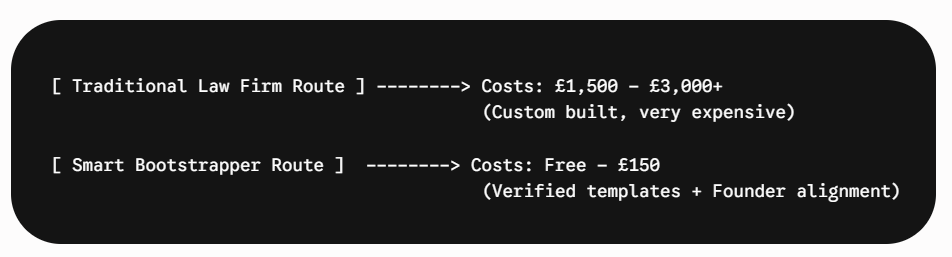
Hiring a corporate London law firm to draft this document can easily wipe out £2,000 of your starting capital. For an early-stage bootstrapped startup, adopt this lean approach:
-
Use Trusted Legal Templates: Platforms like SeedLegals, LawDepot, or standard startup toolkits offer legally sound, UK-compliant draft templates for a fraction of the cost.
-
Have the Uncomfortable Conversations Early: Sit down with your partners and fill out a term sheet together. Agreeing on death, divorce, disability, and disagreement while you are on good terms prevents cataclysmic legal battles later.